

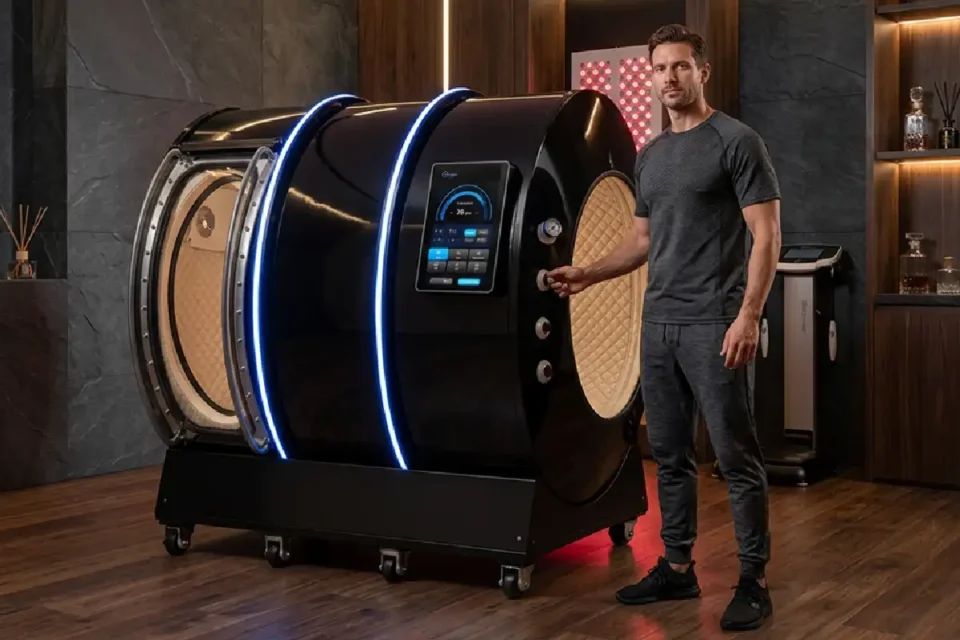
When you push your body in pursuit of peak performance, recovery becomes a necessity. Yet for athletes, the time available for recovery can be brief. Tapping into therapies such as hyperbaric oxygen therapy (HBOT) that accelerate recovery gives athletes a powerful advantage over the competition.
“When working with elite athletes, either while managing a sports medicine clinic or running a training facility, understanding the science behind HBOT can open new pathways for recovery from intense training and competition,” says Michael Carroll, CEO of Oxygen Health Systems. “HBOT is backed by growing scientific evidence, which has inspired its use by numerous NFL, NBA, and MLS franchises as a part of their recovery protocols.”
Caroll is a leader in the hyperbaric technology and wellness industry with nearly a decade of experience. His experience has given him unique insights into how HBOT has evolved from a primarily clinical application to an increasingly accessible tool for wellness, recovery, and performance. Caroll’s expertise covers emerging hyperbaric technology, longevity and biohacking, athlete recovery, and what consumers should know when evaluating hyperbaric therapy and equipment.
Oxygen Health Systems has been a pioneer in HBOT for over a decade, designing and engineering hyperbaric oxygen chambers in the US that are trusted by leading medical centers, medical professionals, and individuals addressing various health conditions at home. Oxygen Health Systems’ chambers deliver oxygen under adjustable variable pressure settings and are also used by a number of professional, multi-billion-dollar sports organizations, including the New York Giants, New York Yankees, Pittsburgh Penguins, San Diego Padres, Minnesota Twins, Inter Miami CF, the US Soccer Federation, and the Chicago Fire — the new home of international soccer star Robert Lewandowski.
“From accelerating tissue repair and enhancing mitochondrial function to reducing inflammation and oxidative stress, HBOT offers multiple pathways for athletes to experience faster and more complete recovery,” Carroll says. “As researchers uncover new mechanisms and clinical applications, its use in sports medicine continues to grow.”
How HBOT supports sports medicine to drive faster recovery
Maximizing the impact of HBOT requires understanding which sports injuries respond best to the treatment. Generally, HBOT speeds recovery by improving oxygen delivery under variable pressure. Consequently, it is most effective in addressing issues in tissue that does not have a healthy blood supply.
“Unlike muscles, tendons and ligaments are marked by a sparse network of blood vessels, which results in an oxygen-poor environment where natural healing happens slowly,” Caroll explains. “HBOT dissolves oxygen directly into blood plasma at levels that are 10 to 15 times higher than normal, which overcomes the oxygen limitations and creates an environment with the potential to accelerate healing.”
HBOT also supports healing by reducing recovery time for tissue impacted by inflammation. Its anti-inflammatory effects speed up the healing process in a way that helps tissue rebuild sooner.
“Injuries resulting from chronic overuse can persist due to incomplete healing cycles,” Caroll says. “HBOT’s ability to stimulate angiogenesis, which involves the building of new blood vessel networks that establish better long-term circulation, can break those cycles and support deeper healing with less downtime.”
How athletes can maximize the benefits of HBOT
Obtaining the best results from HBOT requires embracing actionable strategies. Random use can’t guarantee maximum impact.
“Timing and frequency matter,” Caroll says. “Integration with training cycles also matters. When you understand those nuances and implement them consistently in your treatment, you optimize the impact of HBOT.”
During seasons of heavy training or competition, athletes stand to benefit most from three to five HBOT sessions a week in order to meet the elevated demands of recovery from prolonged, intense physical activity. The increased oxygen delivery HBOT provides under variable pressure helps the body clear out any lingering metabolic waste produced by heavy workouts.
Experts also recommend athletes pair HBOT with proper hydration and nutrition. The therapy can’t have maximum impact if the body doesn’t have the raw materials needed for tissue repair.
“Recovery processes require amino acids for muscle repair, carbohydrates for energy restoration, and adequate hydration for metabolic function,” Caroll says. “Without those, optimal healing won’t happen. Proper hydration and nutrition amplify HBOT’s benefits, ensuring the body can fully utilize the increased and enriched oxygen made available in the pressurized chamber.”
How quickly HBOT can lead to improved athletic performance
The improvements athletes experience from HBOT occur in phases. Some are felt within hours, but others can take weeks of consistent therapy. Understanding when results should be expected can help athletes avoid missteps that prolong injuries.
“It’s possible to begin feeling the effects of HBOT very soon after entering the chamber,” Caroll says. “Blood plasma becomes saturated within the first 60 to 90 minutes of treatment, putting the body into a hyperoxic state that triggers immediate physiological responses.”
Those seeking a reduction in pain or swelling through HBOT may need to wait several days to see results. For minor injuries, such as muscle sprains, HBOT can help athletes achieve functional recovery within a week. With chronic injuries such as tendinitis, athletes should expect four to six weeks of therapy before seeing functional improvements.
Athletes and those who treat and train them should be encouraged by the studies emerging on the effectiveness of HBOT. However, they should also take steps to fully understand when and how to use it, and what type of results they should expect.
“While the evidence that points to HBOT serving as a safe and effective treatment tool for athletes is overwhelming, experiencing optimal results requires engaging in evidence-based practices,” Caroll says. “The therapy works, but careful application of proven principles is needed to ensure it works reliably and consistently.”